

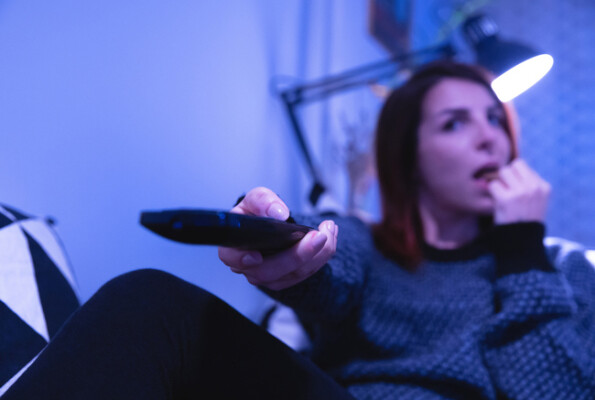
Binge watching and sleep: what really happens to your brain at night
QUICK ANSWER
Binge watching disrupts sleep through two mechanisms: blue light from screens suppresses melatonin, and cliffhangers create a cognitive arousal that keeps the mind active even after the TV is off. 88% of adults report losing sleep because of TV series (AASM). Solutions exist, and they are compatible with keeping your favourite shows.
88% of American adults report losing sleep because of TV series, and among 18–44 year olds the figure rises to 95% (American Academy of Sleep Medicine). A phenomenon so widespread it has its own name: binge watching. But beyond generic advice to 'turn off screens before bed', what does the research actually say about what happens to the brain when we watch one episode after another late into the night?
The mechanism: cognitive arousal and cliffhangers
The problem is not only blue light. A study published in Sleep Medicine in 2023, conducted in a sleep laboratory, analysed the effect of pre-sleep arousal induced by TV series with suspense and cliffhangers. Result: the mind remains in a state of cognitive activation even after the screen is off, thoughts keep spinning, unresolved curiosity, anticipation of the next episode. [1]
This finding aligns with a study on 423 adults aged 18–25 (PMC5529125): binge viewing is associated with worse sleep quality, more fatigue, and more insomnia symptoms compared to regular TV viewing. The key mechanism is pre-sleep cognitive arousal, which fully mediates the relationship between binge watching and sleep disruption. [2]
Risk behaviours and solutions
Behaviour
Effect on sleep
Solution
Screen in the 2h before bed
Melatonin suppression, sleep onset delayed 30-60 min
Turn off at least 1 hour before bed
Episode with cliffhanger
Prolonged cognitive arousal, overactive mind in bed
End on a closed episode, not a season finale
Autoplay on
Loss of control, average +45 min of sleep lost
Disable autoplay in account settings
Watching TV series in bed
Brain stops associating bed with sleep
Watch on the sofa, not in the bedroom
Blue light and melatonin: the chemistry of the problem
Screens emit light primarily in the 460–480 nm band (blue light), which activates photosensitive retinal ganglion cells containing melanopsin. These cells signal the suprachiasmatic nucleus, the biological clock, to inhibit melatonin production. The result: the body fails to 'understand' that it is night. [3]
A 2025 study (Scientific Reports, Nature) measured that blue light from screens keeps melatonin suppressed at 7.5 pg/mL after two hours of evening exposure, while without blue light levels rise to 26.0 pg/mL, more than three times higher. The difference translates to an average sleep onset delay of 30–60 minutes. [4]
What to do without giving up your series
Disable autoplay on Netflix, Prime and Disney+. The next episode starts automatically after 5 seconds — this feature has eliminated the decision moment. Go to account settings and turn off automatic playback.
Choose how to stop. Ending on a narratively resolved episode, not a cliffhanger, reduces residual cognitive arousal. The 2023 laboratory study confirmed that unresolved narrative is the main trigger of mental activation in bed. [1]
Move screen time out of the bedroom. The brain builds powerful associations: if the bed becomes the place where you watch Netflix, it stops being the place where you fall asleep. This distinction, called sleep hygiene in the medical literature, is one of the most validated behaviours for improving sleep quality.
MagniCool: sleep cool after a screen-heavy evening
Prolonged screen use raises body temperature and delays the physiological nighttime cooling that is a biological prerequisite for sleep onset. MagniCool works on two levels: the open-cell Aquabreeze material promotes air circulation and creates an optimal microclimate, while the fabric with microparticles delivers a heat release index twice the UNI EN 14058 standard, helping you fall asleep more easily even after high-arousal evenings.
Discover MagniCool → magniflex.com/en/catalogue/mattresses/magnicool
FAQ
Does binge watching really hurt sleep?
Yes. A study on 423 adults (18–25) demonstrated that binge watching is associated with worse sleep quality, more fatigue, and more insomnia symptoms compared to regular TV viewing. The main mechanism is pre-sleep cognitive arousal, amplified by suspense and cliffhangers.
How long before bed should I stop watching TV series?
At least 30–60 minutes before. Blue light suppresses melatonin in a dose-dependent way: exposure between 9pm and 10:30pm significantly reduces total sleep duration. One hour of distance allows the circadian system to realign.
Do blue light glasses help you sleep better after watching series?
Partially. A 2025 systematic review (Frontiers in Neurology) shows modest improvements in sleep quality, but they do not eliminate cognitive arousal from suspense. The most effective solution remains stopping screen use earlier.
SCIENTIFIC SOURCES
[1] Exelmans L, Van den Bulck J. Pre-sleep arousal induced by suspenseful series. Sleep Medicine, 2023. PMID 36701833.
[2] Exelmans L, Van den Bulck J. Binge Viewing, Sleep, and Pre-Sleep Arousal. PMC5529125.
[3] Blue light influence on sleep and performance. PMC9424753.
[4] Home lighting, blue-light filtering and melatonin suppression. Scientific Reports, Nature, 2025.
[5] AASM Survey: 88% of US adults lose sleep due to binge-watching. aasm.org/sleep-survey-binge-watching-results/
[6] Blue-light blocking glasses on actigraphic sleep outcomes. Frontiers in Neurology, 2025.
[7] Flayelle M et al. This is the last episode: binge-watching and sleep. Journal of Sleep Research, 2023. PMC10078456.